In 2023, the NHVR offered $1.5 million in funding to industry to develop chain of responsibility training.
They did this because they wanted consistent and accurate messaging about the chain of responsibility, the primary duty and the executive duty.
5 years after the amendment there was still mass confusion about these topics and the underpinning concepts of the legal standard of ‘so far as is reasonably practicable’ and the shared responsibility.
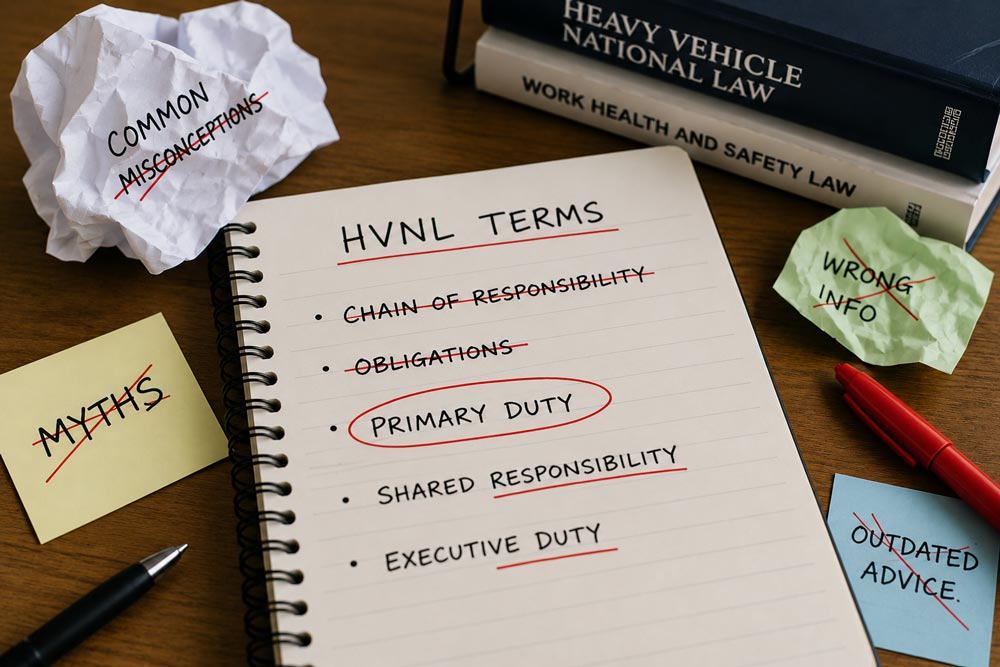
Here’s a quick 101 of some terms used in the HVNL
The chain of responsibility
It’s not a law
They are not obligations
It is the parties named in the HVNL that have a primary duty.
The primary duty
The parties in the chain have a primary duty to ensure, so far as is reasonably practicable, the safety of their transport activities.
THEIR transport activities – not other parties transport activities. One party does not control how another party runs their business.
Reasonably practicable
This is the legal test to consider if a party has controlled a public risk to the full extent expected. It examines 5 elements including the consequences of exposure, what is known about ways to control the risk and the availability and suitability of risk controls. It should never be confused with the reasonable steps defence. They are very different legal standards.
Shared responsibility
The safety of transport activities relating to a heavy vehicle is the shared responsibility of each party in the chain of responsibility for the vehicle.
The shared responsibility does not mean parties share responsibility and legal liability for all transport activities, all the time. It is a shared responsibility in relation to ‘the vehicle’ and just like every load can be different, the extent to which responsibility for transport activities is shared can also be different. It depends on each party’s capacity to control, eliminate or minimise the risk.
Executive duty
Under the HVNL an executive extends beyond directors and officers. It is anyone that is concerned with or takes part in the management of the business. Executives have a duty to ensure the business complies with the primary duty.
They must exercise due diligence to ensure the resources, systems and processes provided to ensure compliance are in use and effective.
Let’s recap
Chain of responsibility
- There is no chain of responsibility legislation.
- There are no chain of responsibility obligations.
- There is a chain of responsibility.
- The chain of responsibility is the parties named in the HVNL that have a primary duty.
Primary duty
The primary duty requires parties in the chain to ensure, so far as is reasonably practicable the safety of their transport activities. This is achieved by
a) eliminating or minimising public risk; and
b) prohibiting conduct that could cause a breach of the Law
Reasonably practicable
This is about doing all that is reasonably practicable to eliminate or minimise a public risk. Not to be confused with taking all reasonable steps to prevent a breach of the Law.
Shared responsibility
Parties have a responsibility for what they do, control and manage and how they respond to what other parties do, but not what the party does.
Executive duty
Executives must ensure the business complies with its primary duty and maintain oversight that systems to do this are implemented and effective.
Amen.